Field Notes

A Note from Sam

I've been working at the leading edge of creative tools for more than three decades.

Across industries. Across continents. Across different ways of seeing.

Most of that time went to creative problems with no obvious answer. That is a lucky place to spend a career. It shaped how I see a story, a frame, a product, a founder trying to explain their vision.

It's also why the work keeps changing. The questions get better. The things I notice get more specific. I care less about making something shiny, and more about finding the one detail that makes the whole thing sing.

Right now I'm in a season where all of it converges, using tools that didn't exist a few months ago. The tools move fast. The work is still judgment. What to pursue. What to let go.

These field notes keep track. What I'm thinking about. What I'm looking at, and what I think makes me interesting and distinctive from all the other AI filmmakers.

Sam

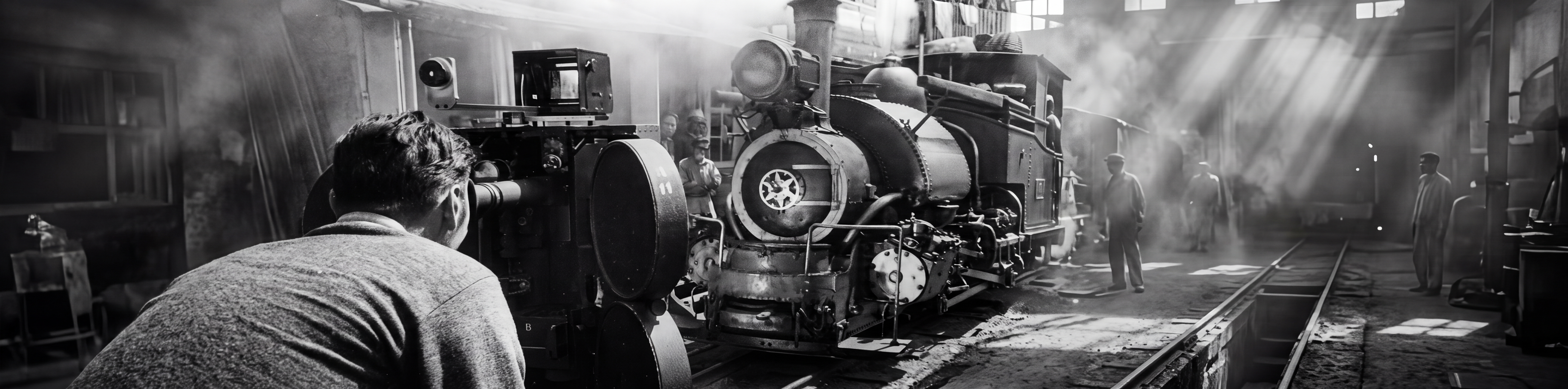
A film camera operator shooting a steam locomotive inside an industrial railway workshop
Film at work.

Most industrial companies do not have a video problem. They have a comprehension problem.

The product may involve machinery, software, logistics, infrastructure, regulation, and several different kinds of customer. The people inside the company know how it all connects. The audience does not.

The answer is not to make the product sound simpler than it is. It is to find the part of the complexity that matters to the person watching. A field-service manager does not want another dashboard. They want to stop learning about problems after the customer does.

Before deciding what a film should show, we need to know who is watching, what they already understand, and what they should believe or do when the film ends. Without those answers, production becomes decoration.

The industry supplies the texture. The director supplies the clarity. The work is not to invent importance. It is to reveal it.

The tools can generate images, motion, dialogue, music, and effects. They still cannot decide what the film should mean.

Generative video has made it possible for one creative director to produce work that once required several vendors and a much larger crew. That does not make the work automatic. It changes where the decisions live.

A strong production starts with a creative and continuity bible: concept, story structure, character identities, world rules, palette, camera grammar, voice, sound, aspect ratios, model roles, and known risks. The bible is the source of truth the production compiles against.

Different tools do different jobs. A still-image model can establish a first frame. A motion model can build movement. Voice, music, editing, compositing, and finishing still need direction. The production is not generated in one pass. It is directed across a set of tools.

When everyone can make something that looks finished, judgment becomes more valuable. The question is not whether a shot can be generated. It is whether the shot belongs in the film.

A homepage video became a character debut, because the stronger problem was not the film. It was the brand's missing character.

A platform for anonymous communication had a moose head as its logo. The mascot needed to be present without demanding attention. A mascot that performs too hard kills a message built on privacy.

The exploration ran wide, then narrowed to a three-option decision. One hero render became the parent file: photoreal moose, smaller antlers, translucent coral glasses. Every frame descended from it.

Character drift is the default state of image models. Describing a character in words lets the face change from frame to frame. Editing from a locked hero render gives every new frame something real to return to.

That one file fathered thirty-three frames. Consistency is not a style guide. It is a parent file and the discipline to keep returning to it.

Every generation costs money and time. Rerolling until something looks right is not a production method.

Before a shot generates, ask what is most likely to fail: texture drift, pose drift, product geometry, character scale, the camera move, or two instructions quietly fighting each other. That is the cheapest step in the pipeline because it costs nothing.

For a character or product that has to stay itself, build the still first. Approve the design, lock the starting frame, and hand that frame to the motion model as a named reference. Appearance without behavior gives you a consistent face doing random things. Behavior without appearance gives you the right energy on the wrong subject.

When an output fails, name what broke before rewriting everything. A contradiction needs a clean restart. Slow degradation needs a return to the last clean version. The cures are opposite.

Continuity can be inherited from one shot to the next, but drift comes with every link. Re-anchor at every new scene or at the first visible sign of change. Prompting at drift is negotiating with a copy of a copy.

The fastest way to ruin a synthetic voiceover is to paste in the script and press generate.

A voice actor gets a director. The read is shaped: where to push, where to sit back, where the line turns. A synthetic voice needs the same direction, except it cannot infer any of it from the room.

Voice direction starts as a writing problem. Short hits give the read somewhere to land. Room gives it somewhere to breathe. If the intended rhythm is not visible on the page, the model cannot hear it either.

A beat tag sets the weather of a line. An inline cue marks the exact word where a pause or inflection lands. Punctuation becomes notation: periods stop, ellipses hold, and capitals hit.

A reveal should change the content, not replace the personality. The voice is the through-line of the film. Direct it like that is true.

It is our understanding of your project, returned to you in a form you can react to before production starts.

You bring us whatever you have: a rough idea, a deck, footage, a product, a script, or a problem that has not found its shape yet. We take in the information and look for what the work actually needs to make happen.

We return a creative vision, the production route, the timeline, and the cost. It should make clear what we are making, why it should work, and what it should not become.

The reverse brief is useful because it puts the thinking on the table before you spend on production. You can challenge the direction while there is still time to change it.

The first useful deliverable is not a shot. It is a clearer direction.

A frame can be technically impressive and still answer the wrong question.

Beauty is not proof that the work is working. Sometimes a frame has the right light, the right texture, and the right finish, but nothing in it helps the audience understand what matters.

The fix is usually not more detail. It is finding the distraction and removing it. A shot should have a job: establish scale, reveal consequence, make an invisible process visible, or give the voice somewhere to land.

Taste is partly the willingness to kill a beautiful frame. The audience does not owe us attention because a render is difficult to make.

The right question is always: what does this frame make clearer?

Real where it counts, generated where it scales, controlled everywhere.

Anything the audience can fact-check should not be casually invented. Product geometry, approved medical evidence, a CEO's voice, a technical proportion, or the detail an expert would notice all need a real source.

The environments, atmosphere, movement, and worlds that would otherwise demand a location scout and a large crew can be generated when that is the right production choice.

The important decision happens before the first frame renders: which parts need evidence and which parts need scale. That is where creative direction and production judgment meet.

The floor has risen. Anyone can generate footage. The bar is judgment.

Industrial companies are not boring. Their marketing becomes boring when it removes the pressure and consequence from the work.

A machine changes what a worker can accomplish. Software changes how a physical operation moves. A logistics system changes whether something arrives. That is already a story.

The work is not to make an industrial company pretend to be a consumer brand. It is to reveal the human and operational stakes that are already there.

Use the material that exists: customer interviews, demonstrations, field footage, photography, drawings, training videos, and sales decks. The question is not whether every asset looks cinematic on its own. It is whether it contains a story.

The industry supplies the texture. The structure, pacing, sound, and point of view make people care what happens next.

Find the smallest true detail that makes the wider story credible, then build outward from it.

It might be the spark in a connector, the correct model number, an approved scan, a product proportion, or a piece of footage that nobody thought was important.

Small details are where trust enters. They give the audience something real to recognize, and they give the film somewhere specific to stand.

Once the detail is locked, the larger world can become more expressive. The generated environment can scale. The camera can move. The design can carry the idea without losing its anchor.

The work is not to add more information. It is to find the one true thing that lets the rest of the story hold.

Experts do not need to see every detail. They do need to know that the details shown are true.

An engineer will notice geometry. A clinician will notice evidence. An operator will notice scale, routing, and what a real shift looks like. Those observations are not obstacles to a compelling film. They are the terms of belief.

The answer is not to drown the audience in specifications. It is to choose the few details that carry authority and protect them through the process.

When a product is difficult to show, we can use design, animation, controlled generation, or existing footage to make the invisible visible. The meaning still has to come from the real product.

Clarity is not the opposite of technical accuracy. It is what lets accuracy travel.

A logo can identify a company. A character can make the company memorable, but only if the character carries the promise.

A mascot is not automatically a character. It becomes one when it has a point of view, a behavior, and a role in the story the brand is trying to tell.

For a privacy product, the character could not behave like a loud advertising prop. Calm and certain was more truthful than cheerful. The direction came from the promise, not from the category of mascot.

Once the character was locked, the film, the website copy, and the handoff materials all inherited the same message architecture. The character was useful because it made the brand coherent.

The question is not whether a mascot looks distinctive. It is whether people can understand what it stands for.

When the available footage shows the helicopter and the lines but not the product, the answer is not to pretend the problem is solved.

Start with what the footage does contain. Find the real moment, the pressure around it, and the detail an engineer would notice. The story can begin at the edge of visibility.

From there, crop, enlarge, animate, or generate the surrounding world with control. The visual decision should make the product easier to understand, not simply make the film more dramatic.

A technical film earns its credibility by staying close to the evidence while giving the audience a clear path through it.

The work did not invent a dramatic technical moment. It found the real one.

You are not only paying for an image. You are paying for someone to notice what the project is really about.

AI can help generate ideas, format a script, write prompts, and keep track of a complex system. It cannot add a lived layer of judgment, taste, and experience to the work by itself.

The director sees the stronger story underneath the brief. They know when a technically correct frame does not sing, when a detail is doing more work than the headline, and when a beautiful direction is pulling the project away from its purpose.

That judgment is also what makes the reverse brief useful. It carries the problem before production, gives you something clear to react to, and keeps the work from becoming a leap of faith.

The tools move fast. The work is still judgment.

The word is scenius: not an individual genius, but the fertility of the entire scene that makes genius possible.

Samuel Andruszkiewicz · @digitalAU · Jan 9 · Read the original on X

Brian Eno's interview with Ezra Klein looks past the usual AI argument and asks what makes creative ecosystems fertile. Eno noticed that the great early twentieth-century Russian painters did not emerge from nowhere. Collectors kept them financially viable. Salons gave ideas somewhere to collide. Travelers carried influences between cities. Cafe owners let artists run tabs because they understood their place in the ecosystem.

There was a whole support system. An ecology of systems. Lots and lots of nodes, connected in very complicated ways. That is scenius. Eno's point is not only that scenius supports genius. It is that scenius creates genius.

The internet had extraction from the beginning. Google made billions indexing other people's work. But it also maintained circulation: it connected you to sources, moved traffic, and let people discover each other. A blog could begin with no expectation of profit. The possibility that someone might find it and read something was enough.

ChatGPT, Claude, and image tools inhale the internet and give the answer directly. The interface does not necessarily route attention outward. It terminates it. News publishers are making deals or blocking crawlers. Artists are fighting unauthorized training or becoming promotional partners for new tools. The old bargain is being renegotiated in real time.

Maybe the result is escape velocity for creation. Maybe media becomes bigger and more distributed. Maybe human work becomes more valuable because there is so much generated sameness. Or maybe the incentive to create outside the mainstream disappears. Nobody knows yet. But scenius is the upstream supply chain of genius, and we need to ask where the next one will come from.

The judgment that makes something good lives in people's heads. What happens when we use today's temporary taste as the foundation for tomorrow's creative tools?

Samuel Andruszkiewicz · @digitalAU · Jan 7 · Read the original on X

The loud AI debate is usually about jobs and automation. The quieter question is what kind of taste we are teaching the systems to reproduce. A conversation about whether AI should be trained on contemporary taste opened a more uncomfortable possibility: perhaps we are encoding the moment we happen to be living through before we know whether it is a cultural peak.

In law, some of the most important knowledge is not written down or codified. It exists in the heads of experts. Creative work is even more dependent on that invisible layer. Each person carries a different calibration of what is good, tired, strange, moving, or worth another look.

The current process can look simple: contractors click prefer A thousands of times, the choices become training data, and the tools learn a version of good from whoever was available to do the work. The problem is not that those people are unintelligent. It is that a temporary, opaque workforce can become the hidden foundation of every creative system that follows.

This may help explain why AI writing has a taste people recognize immediately, why models can feel spiky rather than evenly intelligent, and why so much generated work arrives with the same aesthetic. We are not only building tools. We are deciding which judgments become defaults.

The important questions are not whether the present can be preserved. They are whether this is the era worth enshrining, whose taste is being used, and whether we are all becoming reinforcement-learning inputs. Creative judgment needs circulation, disagreement, and a living scene around it. A foundation should not be mistaken for a finished culture.

Bring us the project.

If you feel like you've seen enough to know that you're ready to go, let's connect.